
eSight Go: Low-Vision Assistive Eyewear · Research, Prototyping, UI Design, Product Strategy
Impact: Designed the end-to-end experience for a next-generation assistive eyewear device across wearable HMI, mobile app, and web portal — building and maintaining a design system that supported development across three integrated platforms over 10 months.
eSight devices are used daily by thousands with over 20 serious eye conditions. eSight Go was eSight’s next product set to launch in 2024.
My Role:
User Research · Prototyping · UI Design · Product Strategy · Design System Owner
Tools:
Figma (Designs) · Jira/Confluence (Sprint + Content Management) · Photoshop (Testing Materials)
Team:
Product, Engineering, Hardware, and external industrial design partner (Gentex)
Duration:
12 months
The Product
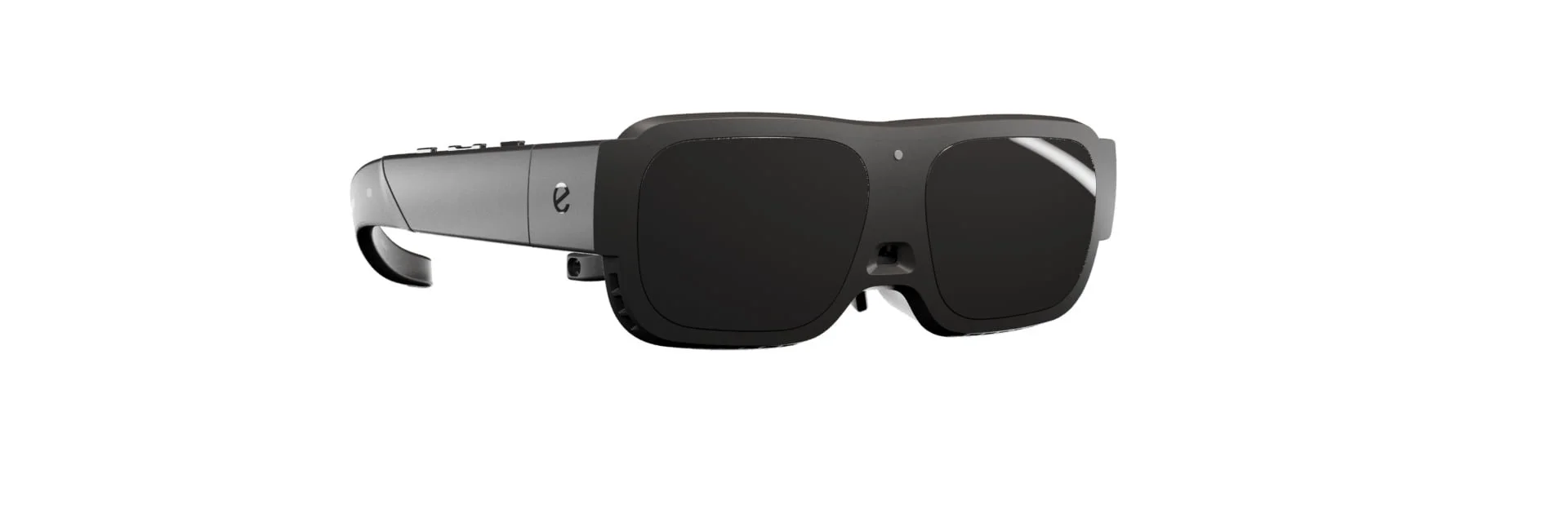
eSight's eyewear enables people with legal blindness to achieve 20/20 enhanced vision. Through a camera lens and image processing technology, it delivers high-quality visual information to improve vision at near and far distances. eSight devices are used daily by thousands of people with over 20 serious eye conditions. eSight Go was the company's next-generation product, set to launch in 2024.
The Problem
User pain points centered on two areas:
Form factor — the device was heavy and visually conspicuous
Experience — navigating the product was difficult, both physically and digitally
The goal was to create a more discreet, sleek, advanced device that further improved user vision — and to improve the experience across both the physical device and its digital touchpoints.

What I Did

2. Owned research across both digital and physical prototypes.
I conducted interviews and usability testing on industrial design prototypes as well as UI usability tests on the eyewear screens. Remote testing was not viable — the users were older adults with disabilities, the product was physical, and this ran during Covid, when elders were particularly uncomfortable being in a closed room with others. Every round had to be in person, on real hardware.
3. Designed across three integrated platforms.
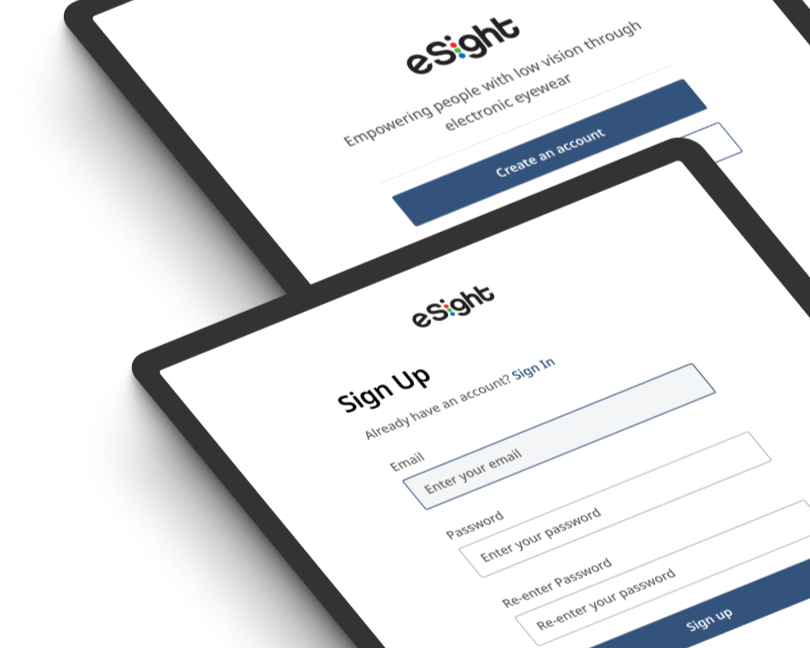
Mobile app — an upgrade integrating the new-generation eyewear with an all-new design: account creation and management, alternate Wi-Fi connection for the eyewear, device registration and pairing, and remote control for the eyewear.
Eyewear HMI — the on-device screens where users maximize their vision: zoom in/out, brightness and color contrast adjustment, freeze view, and auto focus. I designed for seamless control through high-contrast indicators, large fonts, and voice.
Web portal — a revamp of the existing site into a portal serving users, admins, distributors, sales, and support: account and device management, a feature allowing a user's loved ones to see their view through the eyewear, and support access.


5. Worked within real constraints.
The problems were complex. We needed to maximize vision benefits for users, make the physical product significantly sleeker than the previous generation, and tailor the digital experience across all platforms for low vision — all within technical and budget constraints. We partnered with US industrial design company Gentex to build and iterate prototypes, testing each version against those constraints. I was involved across 5 hardware iterations.
4. Built and maintained the design system.
I built and maintained a design library covering web, mobile, and wearable interfaces, plus prototypes to support development implementation.
1. Ran in-person research with low-vision users.
I began with semi-structured interviews with current eSight 4 users to understand their daily activities, everyday concerns, product usage, and pain points. Because our target users are individuals with low vision, interviews had to be conducted in person — which also let me connect directly with each participant rather than through a screen. In parallel, I conducted market research and competitive analysis to understand the landscape and similar products.

Results
Designed and shipped the digital experience for eSight Go across wearable HMI, mobile app, and web portal — three integrated platforms with a shared design system.
Conducted in-person research and usability testing across 5 physical prototype iterations with low-vision users.
Built the design system and prototypes that supported development implementation through launch.
(Product launched in 2025; I transitioned to a new role before launch) - https://www.esighteyewear.com/esight-go/
Reflection
This was the project where I learned to design under constraints that pulled against each other. Users needed maximum visual capability; the business needed a sleeker, more discreet device; engineering needed it buildable within budget; and every digital surface had to be accessible to people with low vision. Those pressures don't resolve neatly — you make trade-offs and test your way forward.
It was also my first time designing for a mix of physical and digital product across multiple platforms, and my first time working closely with users with disabilities — including coworkers. That pushed me to study accessibility and inclusive design intensively, and to run research in person, on hardware, with older adults, during a period when that was genuinely difficult. I joined as an intern with limited knowledge of wearable and accessible design, and was given a full-time position three months in. The experience shaped me into a well-rounded designer who can own research, design, systems, and cross-platform delivery on a complex product.